Rent
ELERS MEDICALs antimikrobiella draperier tillverkas med en beprövad antimikrobiell tillsats i fibrerna, som hjälper till att minska bakteriemängden på tygets yta. Draperityget har visat effekt mot flera organismer som MRSA, Staphylococcus aureus, Klebsiella pneumoniae och Escherichia coli, och draperiernas effekt har testats oberoende enligt den internationellt erkända standarden för antimikrobiella textilier ISO 20743:2021. Komplett produktsortiment
Både antimikrobiella och vanliga (obehandlade) draperier finns i ett brett urval av storlekar och färger. Stöd hållbar utveckling Slut på tidskrävande tvättprocesser som förbrukar vatten och tvättmedel.
Säkert
Säkrare för patienter, personal och besökare. Draperierna uppfyller och är registrerade enligt REACH- och ECHA-förordningarna samt hos EPA i USA. Tillverkade under det certifierade kvalitetsledningssystemet ISO 9001:2015 och miljöledningssystemet ISO 14001:2015.
Enkelt och snabbt byte
Engångsdraperier förbättrar hygienen på sjukhus utan tvättprocesser och sparar tid och resurser. Ett brett urval av upphängningssystem finns, och de passar de flesta vanliga skensystem.
Ekonomisk lösning
Engångsdraperier byts ut i stället för att tvättas, så det blir ingen tvätt, torkning eller förvaring av återanvändbara draperier.
Kostnadseffektivt
Ingen tvätt och inga kostsamma startinvesteringar. Betydande kostnadsbesparingar jämfört med traditionella textildraperier.
Internationella godkännanden för brandhämmande egenskaper (FR)
Både antimikrobiella och vanliga draperier är brandhämmande (FR) i sig, och de brandhämmande egenskaperna är oförändrade under produktens hela livscykel. De brandhämmande egenskaperna har testats enligt standarderna EN 13773, BS 5867: Part 2 Type C och NFPA 701.
Enkel spårbarhet
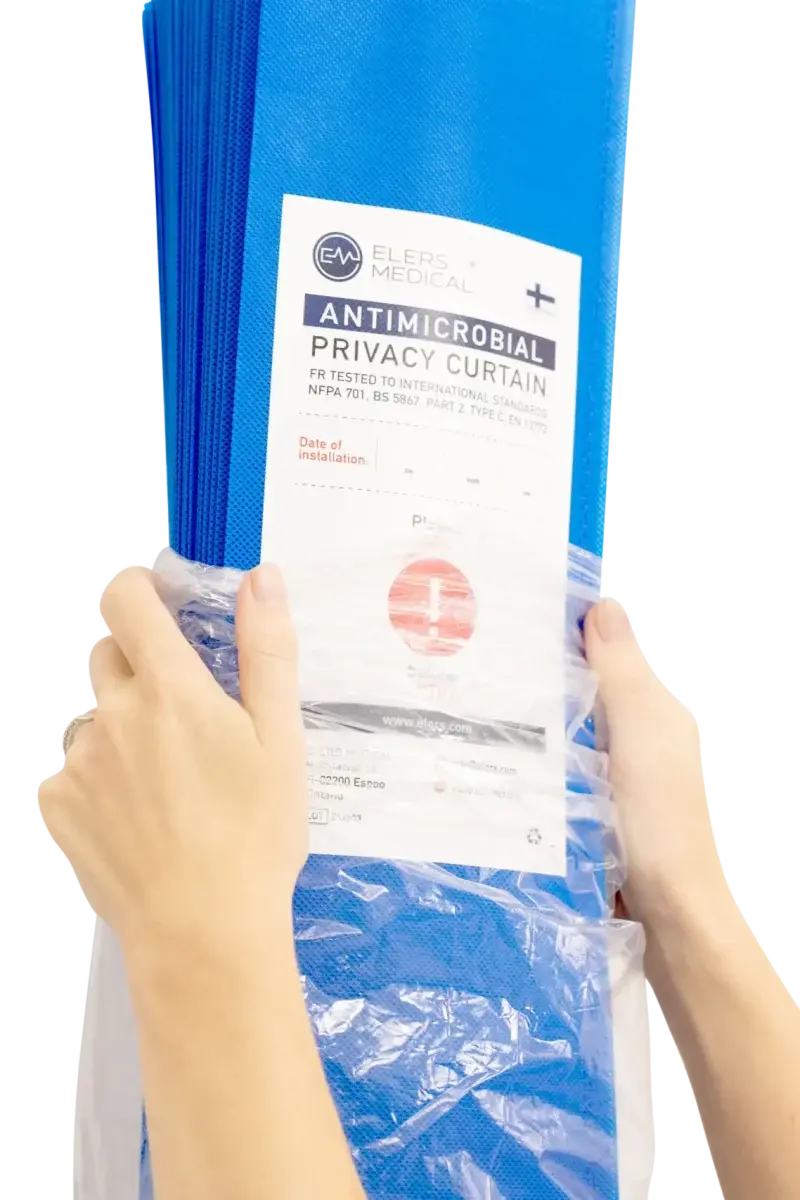
Värmeförseglade etiketter för egenkontroll och integritet med ett unikt identifieringsnummer för spårbarhet.
Återvinningsbart och miljövänligt
Vi använder mellan 10 och 20 % återvunnet material i tillverkningen, och efter användning kan produkten återvinnas upp till 100 %.
Sjukhus och kliniker Vårdenheter och öppenvårdsmottagningar Vårdboenden och äldreboenden Operationssalar och infektionsavdelningar
Behöver du även ett fristående eller väggmonterat alternativ? Se våra mobila och väggmonterade vikskärmar.
Draperisortiment
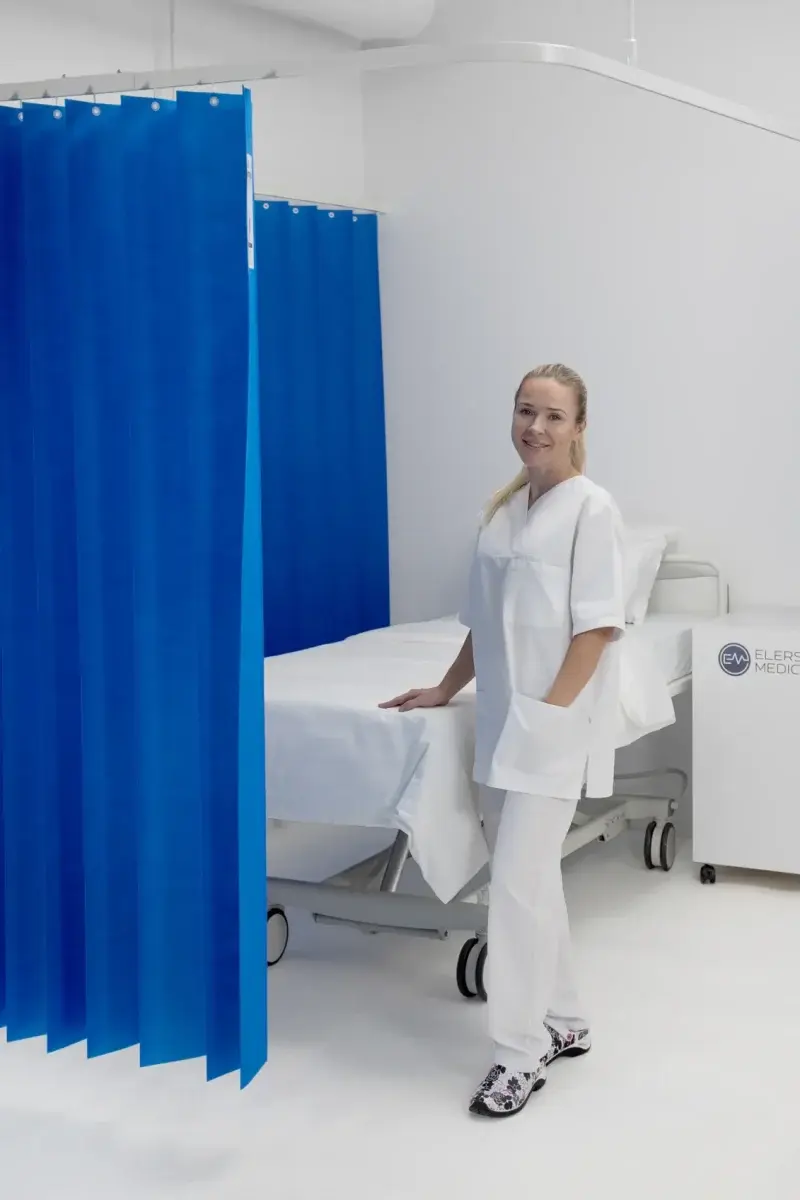
Draperier för vårdrum från ELERS MEDICAL® finns med antimikrobiella egenskaper eller som vanliga draperier utan antimikrobiell behandling. Båda alternativen har samma brandhämmande egenskaper under hela livscykeln. Draperierna finns i ett brett urval av storlekar, modeller och färger, och specialanpassade alternativ finns på begäran.
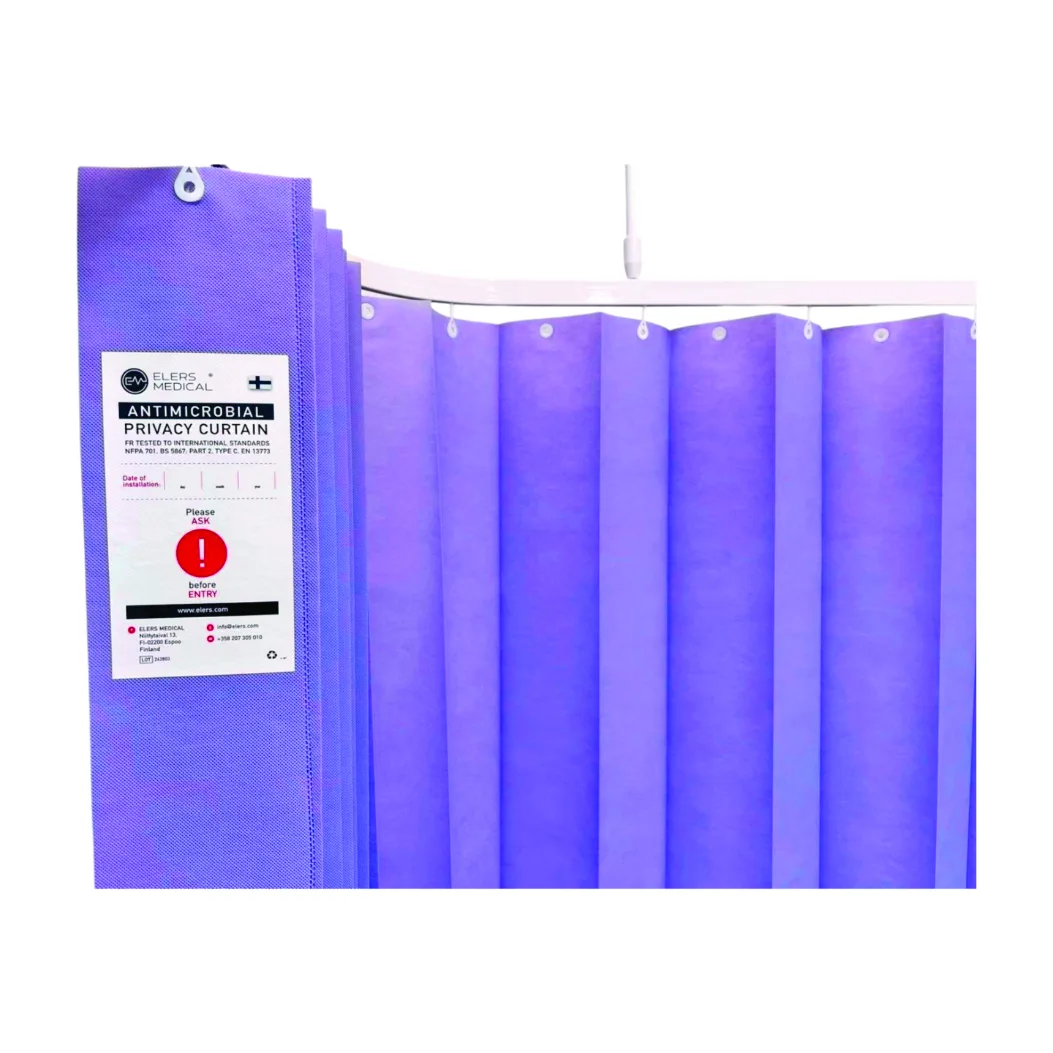
För områden där patientsäkerheten är avgörande. Det antimikrobiella skyddet tillförs nonwoven-tyget redan vid tillverkningen, och materialet är testat enligt ISO 20743:2021 mot MRSA och andra organismer under draperiets hela livscykel.
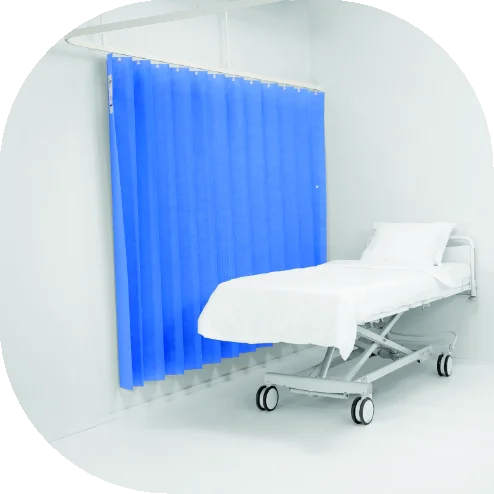
Ett prisvärt draperi för områden med lägre risk och hög patientomsättning. Samma storlekar, färger och brandegenskaper som det antimikrobiella draperiet.
Heltäckande draperi utan urtag eller nätdelar. 11 färger och ballongmönstret, alla som antimikrobiella draperier och standarddraperier.
Perforeringen låter luften cirkulera runt sängplatsen och gör att takmonterade sprinklersystem fungerar. Finns i antimikrobiellt utförande och standardutförande.
Rätt val för takmonterade skenor. Finns i antimikrobiellt utförande och standardutförande.
Utvecklat och designat av ELERS MEDICAL i Finland.
Standardfärger och mönster
Alla färger och ballongmönstret finns som antimikrobiella draperier och standarddraperier, i heltäckande och perforerat utförande samt med nätad ovandel. Specialfärger och tryck finns; minsta beställningsmängd gäller.
Färgerna på skärmen är ungefärliga. Be oss om ett tygprov innan du beställer.
Krokguide
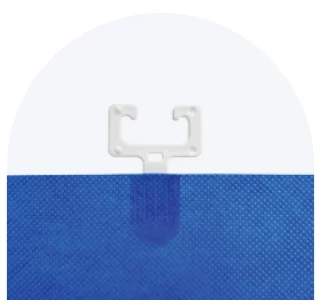
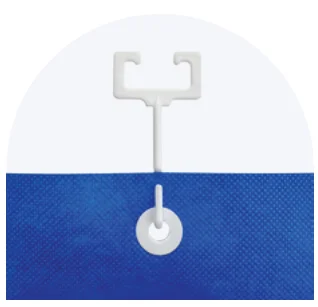
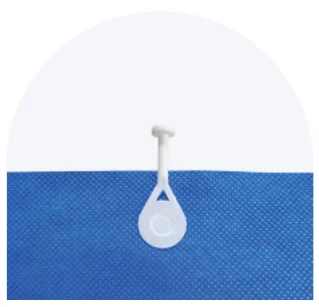
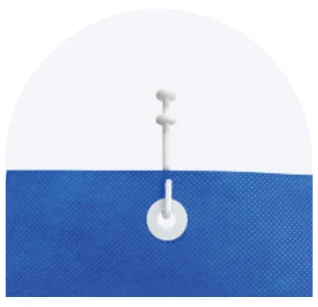
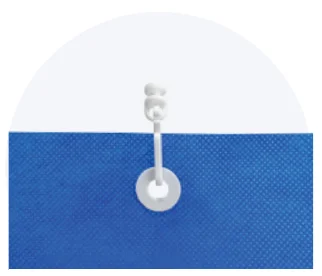
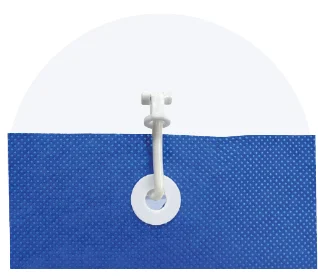
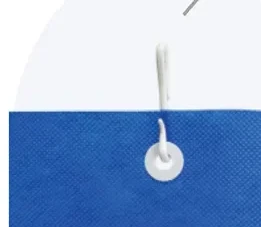
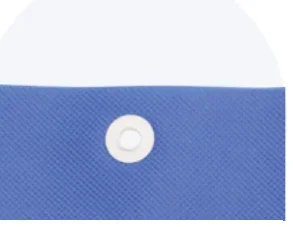
ELERS MEDICALs draperier passar de flesta vanliga draperiskenor i vårdmiljöer och kan levereras antingen med krok eller endast med öljett. Vårt urval ger en smidig anpassning till befintliga krok- och glidsystem. Osäker på vilken du behöver? Skicka oss skenans märke och modell eller ett foto av skenan och nuvarande krok.
Storlekar och förpackning
Mät längden på skenan som draperiet ska täcka och välj det draperi vars användbara bredd motsvarar den. Den användbara bredden tar hänsyn till vecken när draperiet hänger.
| Bredd \ höjd | 2,0 m | 2,2 m | 2,4 m | 2,5 m | 2,6 m |
|---|---|---|---|---|---|
| 1.95 | 18 | 16 | 15 | 14 | 14 |
| 2.40 | 14 | 13 | 12 | 11 | 11 |
| 2.55 | 14 | 13 | 11 | 10 | 9 |
| 3.60 | 12 | 11 | 10 | 10 | 9 |
| 3.75 | 12 | 11 | 10 | 10 | 9 |
| 4.20 | 10 | 9 | 8 | 8 | 8 |
| 4.50 | 9 | 8 | 8 | 7 | 7 |
| 5.55 | 8 | 7 | 7 | 6 | 6 |
| 7.20 | 6 | 6 | 5 | 5 | 5 |
| 7.50 | 6 | 5 | 4 | 4 | 4 |
| Draperiets bredd (m) | Ungefärlig användbar bredd (m) |
|---|---|
| 1.95 | 1.55 |
| 2.40 | 1.80 |
| 2.55 | 2.05 |
| 3.60 | 2.80 |
| 3.75 | 2.90 |
| 4.20 | 3.40 |
| 4.50 | 3.60 |
| 5.55 | 4.30 |
| 7.20 | 5.60 |
| 7.50 | 5.75 |
Fler specialhöjder finns på begäran. Kartongens vikt cirka 10,5 kg. Kartongens mått 120 × 16,5 × 40 cm.
Monteringsanvisning
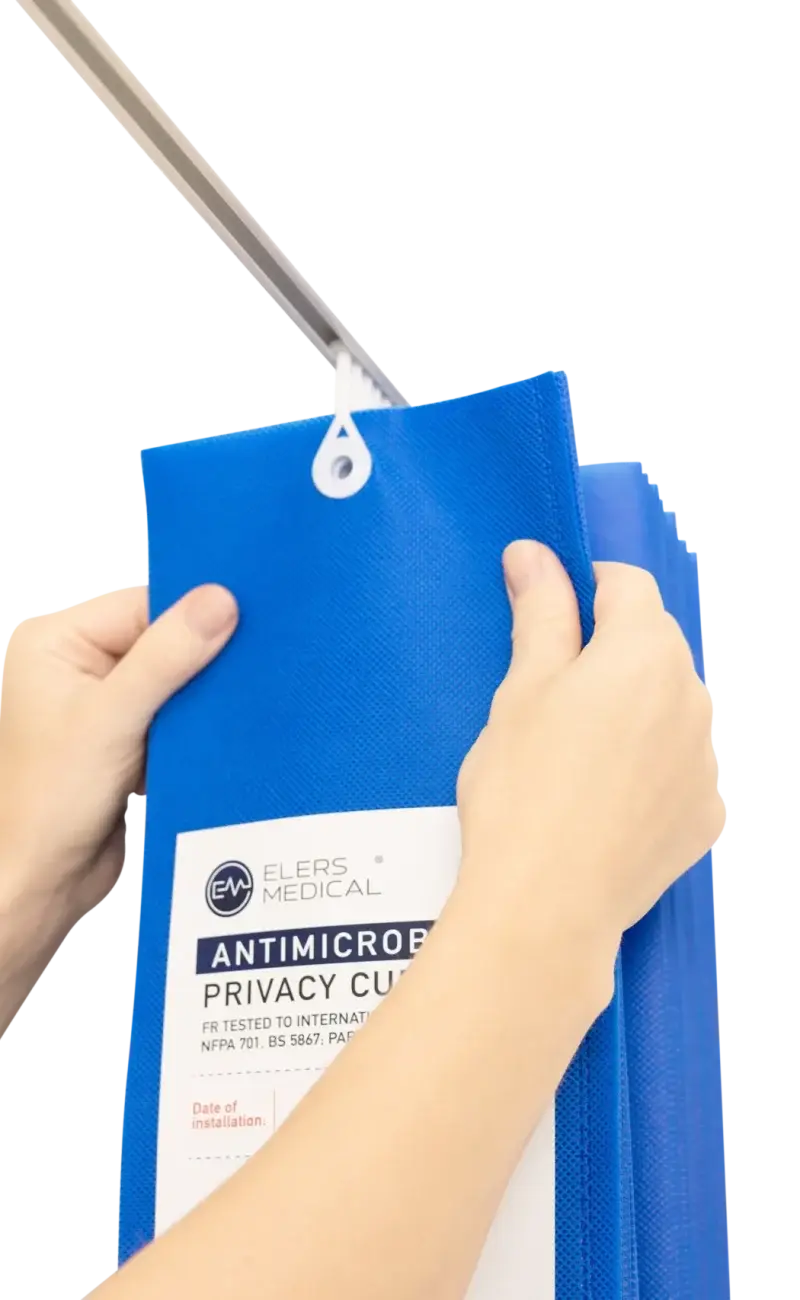
Dra ner plasthöljet så att etiketten för egenkontroll syns och skriv in monteringsdatumet.
Sätt krokarna direkt på skenan. Draperierna levereras enligt dina önskemål, med krokar eller endast med öljetter.
Ta bort plasthöljet helt när draperiet har hängts upp.
Förvara draperierna torrt i normal rumstemperatur med kartongen stående.
Vi rekommenderar att draperierna byts var 6:e till 12:e månad, eller omedelbart om de blir synligt smutsiga eller kontaminerade. Sjukhusets egna riktlinjer avgör det slutliga schemat.
Draperityget är polypropen (PP) och krokarna och öljetterna är av plast. Draperierna kan återvinnas eller kasseras enligt sjukhusets lokala rutiner.
Oberoende testat
I tester enligt ISO 20743:2021 minskar det antimikrobiella draperimaterialet ett brett spektrum av patogener med mer än log 3 (99,9 %).
Ytterligare tester på begäran.
Antibakteriellt värde (A): 2 ≤ A < 3 signifikant, A ≥ 3 starkt. Testerna har utförts under laboratorieförhållanden. Fullständiga testresultat på begäran.
Brandhämmande under draperiets hela livslängd.
Publicerad forskning
Draperier i vårdrum vidrörs ständigt och byts sällan. Dessa referentgranskade studier visar hur snabbt vanliga draperier kontamineras och vad silverbaserade antimikrobiella material gör åt det.
“By day 3, test curtains showed increased microbial contamination (mean colony-forming units [CFU]/cm2 = 1.17) compared to control curtains (mean CFU/cm2 = 0.19). Test curtains became increasingly contaminated over time, with mean CFU/cm2 for days 17 and 21 of 1.86 and 5.11, respectively. By day 10, 1/8 test curtains tested positive for MRSA, and 5/8 were positive by day 14. Patient privacy curtains became progressively contaminated with bacteria, including MRSA. Between days 10 and 14 after being hung, curtains showed increased MRSA positivity. This may represent an opportune time to intervene, either by cleaning or replacing the curtains.”
“There was a statistically significant difference for the contact (t = 2.10, P =.047) and noncontact (t = 2.62, P =.016) rooms, with the edges having a significantly higher median than the middles. Pathogens such as methicillin-resistant Staphylococcus aureus, Enterococcus, Klebsiella, and Acinetobacter were found on the curtains, though at lower rates than in previous studies. Opportunistic fungi were also found on all curtains. Conclusions: Results of this study confirm that hospital curtains, most notably the edge but also the middle, are contaminated with pathogens, and that these areas are frequently touched by health care workers in between hand hygiene.”
“The cumulative contamination rate of the hospital privacy curtains increased over time (week 2: 15.6%, week 4: 37.0%, and week 8: 55%). Methicillin-resistant Staphylococcus aureus was not isolated from either the control or the hospital curtains during the study period. Vancomycin-resistant enterococci was not isolated from the control curtains but was isolated from 11.8% (4/34) of the hospital curtains. The contamination rate of the hospital curtains increased over time and showed a tendency to rise with an increase in the number of beds in a room.”
“Participants hands were heavily contaminated at baseline, in some cases with potentially pathogenic species. Half of the participants (n=30) acquired bacteria on their fingertips from handling curtains, illustrating that privacy curtains may be involved in the transmission of infection to emergency department patients.”
“In a culture survey (n=50), we found that 42% of hospital privacy curtains were contaminated with a antibiotic-resistant enterococci, 22% with methicillin-resistant Staphylococcus aureus, and 4% with Clostridium difficile. Hand imprint cultures demonstrated that these pathogens were easily acquired on hands. Hospital curtains are a potential source for dissemination of healthcare-associated pathogens.”
“From 32 curtains sampled, a total of 59 isolations were obtained, from those, 47 (79.6%) were considered potentially clinically relevant (Table 2), highlighting bacteria as Methicillin-resistant S. haemolyticus (MRSH), Methicillin-resistant S. cohnii (MRSC), MRSE, Methicillin-resistant S. saprophyticus (MRSS), Moraxella sp., Acinetobacter ursingii, AMP-C producer Pseudomonas oryzihabitans, Pantoea agglomerans, and Sphingomonas paucimobilis… There are significant opportunities to reduce patient exposure to frequently pathogenic bacteria in the hospital setting; patients are likely exposed to many bacteria through direct contact with white coats, curtains, and ties.”
“Twelve of 13 curtains (92%) placed during the study showed contamination within 1 week. Forty-one of 43 curtains (95%) demonstrated contamination on at least 1 occasion, including 21% with MRSA and 42% with VRE. Eight curtains yielded VRE at multiple time points: 3 with persistence of a single isolate type and 5 with different types, suggesting frequent recontamination. Privacy curtains are rapidly contaminated with potentially pathogenic bacteria.”
“Privacy curtain contamination on the burns/plastic surgery ward was determined for two separate occasions six months apart: 23 curtains on August 2015 and 26 curtains on January 2016… Curtain contamination in August 2015 was 0.7–4.7 cfu/cm2 with 22% testing positive for MRSA, whereas contamination on January 2016 was 0.6–13.3 cfu/cm2 with 31% of curtains testing positive for MRSA. Curtains on the burns/plastic surgery ward become colonized with significant quantities of bacteria.”
“Environmental screening revealed the presence of the multiple-resistant Acinetobacter species on fomite surfaces in the intensive care unit and bed linen. The major source appeared to be the curtains surrounding patients' beds. Typing by pulsed field gel electrophoresis demonstrated that the patients' isolates and those from the environment were indistinguishable… This outbreak also highlights environmental sources, particularly dry fabrics such as curtains, as an important reservoir for dissemination of acinetobacters.”
“The purpose of this study was to determine the survival of 22 gram-positive bacteria (vancomycin-sensitive and -resistant enterococci and methicillin-sensitive and -resistant staphylococci) on five common hospital materials: smooth 100% cotton (clothing), 100% cotton terry (towels), 60% cotton–40% polyester blend (scrub suits and lab coats), 100% polyester (privacy drapes), and 100% polypropylene plastic (splash aprons)… All isolates survived for at least 1 day, and some survived for more than 90 days on the various materials… The long survival of these bacteria, including MRSA and VRE, on commonly used hospital fabrics, such as scrub suits, lab coats, and hospital privacy drapes, underscores the need for meticulous contact control procedures and careful disinfection to limit the spread of these bacteria.”
“Curtains in the experimental group demonstrated significantly lower bacterial contamination than controls at all time points (P < .001). Peak contamination in the control group reached 2.1 CFU/cm² at day 30, whereas experimental curtains maintained contamination below 0.2 CFU/cm² throughout. Cost analysis revealed a 59.42% reduction in cumulative curtain-related expenditures in the experimental group. Antimicrobial disposable curtains offer superior microbial control and substantial cost savings. Integration of such curtains into infection prevention protocols may enhance environmental hygiene and resource optimization in critical care settings.”
“Bacteria were exposed to the silver ion solution for various lengths of time, and the antibacterial effect of the solution was tested… Reductions of more than 5 log10 CFU/ml of both S. aureus and E. coli bacteria were confirmed after 90 min of treatment with the silver ion solution. Significant reduction of S. aureus and E. coli cells was also observed by FC analysis… In conclusion, the results of the present study suggest that silver ions may cause S. aureus and E. coli bacteria to reach an ABNC state and eventually die.”
“A declining pipeline of clinically useful antibiotics has made it imperative to develop more effective antimicrobial therapies, particularly against difficult-to-treat Gram-negative pathogens. Silver has been used as an antimicrobial since antiquity, yet its mechanism of action remains unclear. We show that silver disrupts multiple bacterial cellular processes, including disulfide bond formation, metabolism, and iron homeostasis. These changes lead to increased production of reactive oxygen species and increased membrane permeability of Gram-negative bacteria that can potentiate the activity of a broad range of antibiotics against Gram-negative bacteria in different metabolic states, as well as restore antibiotic susceptibility to a resistant bacterial strain… This work shows that silver can be used to enhance the action of existing antibiotics against Gram-negative bacteria, thus strengthening the antibiotic arsenal for fighting bacterial infections.”
“The resulting silver sulfadiazine–immobilized celluloses provided a 6-log reduction of 10^8 CFU mL−1 of Staphylococcus aureus (Gram-positive bacteria), Escherichia coli (Gram-negative bacteria), methicillin-resistant Staphylococcus aureus (drug-resistant bacteria), vancomycin-resistant Enterococcus faecium (drug-resistant bacteria), and Candida albicans (fungi) in 30–60 minutes, and a 5-log reduction of 10^7 PFU mL−1 of MS2 virus in 120 minutes. The antibacterial, antifungal, and antiviral activities were both durable and rechargeable. Additionally, trypan blue assay suggested that the new silver sulfadiazine–immobilized celluloses sustained excellent mammal cell viability, pointing to great potentials of the new materials for a broad range of health care–related applications.”
ELERS MEDICAL®
Elers Medical Finland Oy har två certifikat för ledningssystem: ISO 9001:2015 och ISO 14001:2015 för miljöledning.
Mät längden på skenan som draperiet ska täcka och använd sedan den användbara bredden för att välja ett draperi som täcker tillräckligt med vecken på plats. Standardbredderna är från 1,95 m till 7,50 m och höjderna från 2,0 m till 2,6 m. Ett draperi på 1,95 m täcker cirka 1,55 m skena och ett draperi på 7,50 m cirka 5,75 m. Specialbredder och specialhöjder finns på begäran; minsta beställningsmängd och längre leveranstid kan gälla.
ELERS MEDICALs draperier passar de flesta skensystem på sjukhus när de används med rätt krok. Ett alternativ med endast öljetter finns för användning med befintliga kompatibla krokar. Om du är osäker på vilken upphängning du ska beställa kan du skicka oss skenans märke och modell eller ett foto av skenan och nuvarande krok, så hjälper vi dig att hitta rätt.
Ja. ELERS MEDICAL använder en halogenfri brandhämmande tillsats i draperityget. Dokumentation om brandegenskaper finns på begäran, bland annat testresultat för BS 5867-2:2008 Type C och NFPA 701 samt klassificeringen enligt EN 13773.
Behandlingen är utformad för att hämma bakterietillväxt på draperityget. Tyget har testats enligt ISO 20743, en internationell testmetod för att mäta antibakteriell aktivitet i textilier. Testdokumentation finns på begäran.
ELERS MEDICAL rekommenderar att draperierna byts var 6:e till 12:e månad, eller tidigare om sjukhusets riktlinjer för vårdhygien kräver det. Följ det lokala bytesschemat för varje vårdområde. Byt draperierna omedelbart om de blir synligt kontaminerade med blod eller andra kroppsvätskor.
Varje draperi har en etikett för egenkontroll på det främre vecket där personalen kan skriva datumet då det hängdes upp. Personalen kan använda datumet för att se när draperiet senast byttes och räkna ut när nästa rutinbyte ska göras.
Sortimentet omfattar Pacific Blue, Summer Blue, Light Blue, Light Green, Pastel Yellow, Latte, Forest Green, Battleship Grey, Lilac, Pink, White och Balloon Print. Andra färger kan finnas på begäran, med förbehåll för minsta beställningsmängd och leveranstid.
Följ sjukhusets avfallspolicy och lokala rutiner för vårdhygien när använda draperier tas ner och kasseras, och avgör utifrån dem rätt avfallsflöde, till exempel smittförande avfall eller hushållsavfall. Draperityget är tillverkat av 100 % polypropen. Om ett använt draperi kan återvinnas beror på hur avfallet klassas och vad avfallsentreprenören eller de lokala hygienrutinerna kräver.
Berätta vilka draperier du behöver så återkommer vi med en offert.