Temiz
ELERS MEDICAL antimikrobiyal perdeler, liflere eklenmiş kanıtlanmış bir antimikrobiyal katkı maddesiyle üretilir ve kumaş yüzeyindeki bakteri yükünün azaltılmasına yardımcı olur. Perde kumaşının MRSA, Staphylococcus aureus, Klebsiella pneumoniae ve Escherichia coli gibi birçok organizmaya karşı etkili olduğu kanıtlanmıştır ve perdelerin etkinliği uluslararası kabul görmüş antimikrobiyal tekstil standardı ISO 20743:2021'e göre bağımsız olarak test edilmiştir. Eksiksiz ürün yelpazesi
Hem antimikrobiyal hem de standart (işlemsiz) perdeler geniş bir boyut ve renk seçeneğiyle sunulur. Sürdürülebilir kalkınmaya destek Zaman, su ve deterjan tüketen yıkama süreçlerine son.
Hastane perdelerinin arkasındaki bilim: 14 yayımlanmış çalışma
Güvenli
Hastalar, personel ve ziyaretçiler için daha güvenli. Perdeler REACH ve ECHA mevzuatına uygundur ve bu mevzuat kapsamında, ayrıca ABD'de EPA nezdinde kayıtlıdır. Sertifikalı ISO 9001:2015 kalite yönetim sistemi ve ISO 14001:2015 çevre yönetim sistemi kapsamında üretilir.
Kolay ve hızlı değişim
Tek kullanımlık perdeler, yıkama süreçlerine gerek kalmadan hastane hijyenini iyileştirir, zaman ve kaynak tasarrufu sağlar. En yaygın ray sistemlerinin çoğuyla uyumlu geniş bir asma sistemi yelpazesi mevcuttur.
Ekonomik çözüm
Tek kullanımlık perdeler yıkanmak yerine değiştirilir; böylece yeniden kullanılabilir perdelerin yıkanması, kurutulması ve depolanması gerekmez.
Uygun maliyetli
Yıkama ve maliyetli ilk yatırım harcaması yok. Geleneksel tekstil perdelere göre önemli tasarruf.
Uluslararası alev geciktiricilik (FR) onayları
Hem antimikrobiyal hem de standart hasta bölme perdeleri doğası gereği alev geciktiricidir (FR) ve bu özellikleri ürünün tüm yaşam döngüsü boyunca değişmez. Alev geciktirici özellikler EN 13773, BS 5867: Part 2 Type C ve NFPA 701 standartlarına göre test edilmiştir.
Kolay izlenebilirlik
İzlenebilirlik için benzersiz bir kimlik numarası taşıyan, ısıyla yapıştırılmış öz denetim ve mahremiyet etiketleri.
Geri dönüştürülebilir ve çevre dostu
Üretimde yüzde 10 ile 20 arasında geri dönüştürülmüş malzeme kullanıyoruz ve kullanım ömrü sona erdiğinde ürün yüzde 100'e kadar geri dönüştürülebilir.
Hastaneler ve klinikler Sağlık birimleri ve poliklinikler Huzurevleri ve yardımlı yaşam tesisleri Ameliyathaneler ve enfeksiyon servisleri
Ayaklı veya duvara monteli bir seçeneğe de mi ihtiyacınız var? İnceleyin: tekerlekli ve duvara monteli paravanlarımız.
Perde yelpazesi
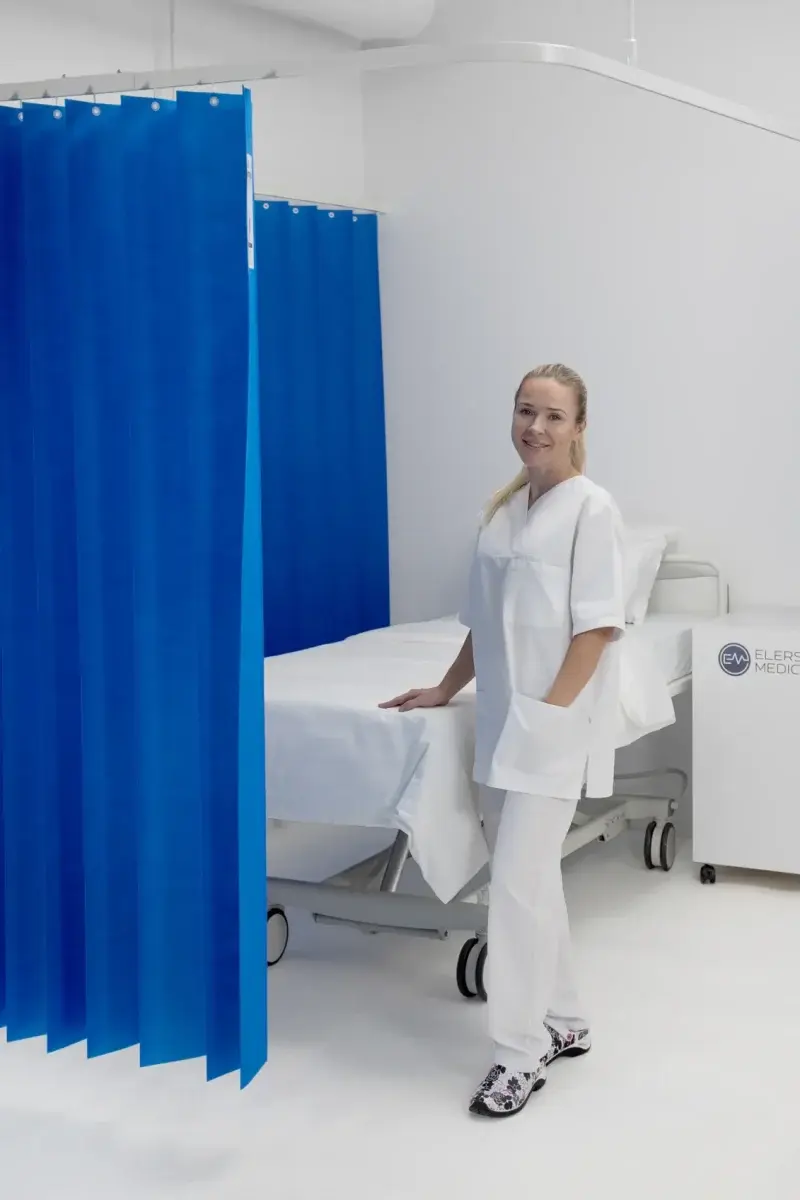
ELERS MEDICAL® hasta bölme perdeleri antimikrobiyal özellikli veya antimikrobiyal işlem görmemiş standart perdeler olarak sunulur. Her iki seçenek de yaşam döngüsü boyunca aynı alev geciktirici özelliklere sahiptir. Perdeler geniş bir boyut, kesim ve renk yelpazesinde sunulur; özel seçenekler talep üzerine hazırlanır.
Hasta güvenliğinin en önemli olduğu alanlar için. Antimikrobiyal koruma, üretim aşamasında dokusuz kumaşa entegre edilir ve malzeme, perdenin tüm yaşam döngüsü boyunca MRSA ve diğer organizmalara karşı ISO 20743:2021'e göre test edilmiştir.
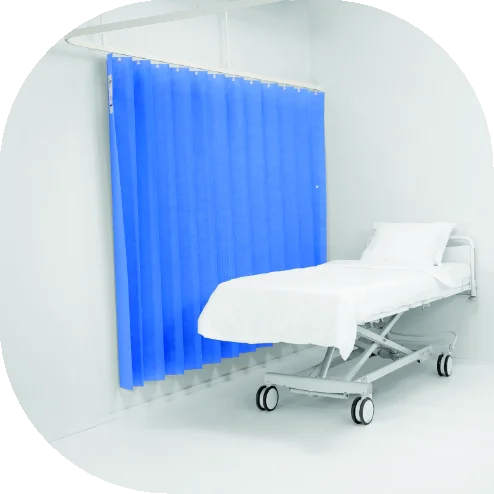
Daha düşük riskli ve hasta sirkülasyonu yüksek alanlar için ekonomik bir perde. Antimikrobiyal perdeyle aynı boyutlar, renkler ve yangın performansı.
Delik veya file bölümü olmayan tam kapalı perde. 11 renk ve balon desenli baskı, hepsi antimikrobiyal ve standart olarak mevcuttur.
Delikler yatak alanının çevresinde hava sirkülasyonu sağlar ve tavana monte sprinkler sistemlerinin çalışmasına izin verir. Antimikrobiyal ve standart olarak mevcuttur.
Tavana sabitlenmiş raylar için doğru seçim. Antimikrobiyal ve standart olarak mevcuttur.
ELERS MEDICAL tarafından Finlandiya'da tasarlanmış ve geliştirilmiştir.
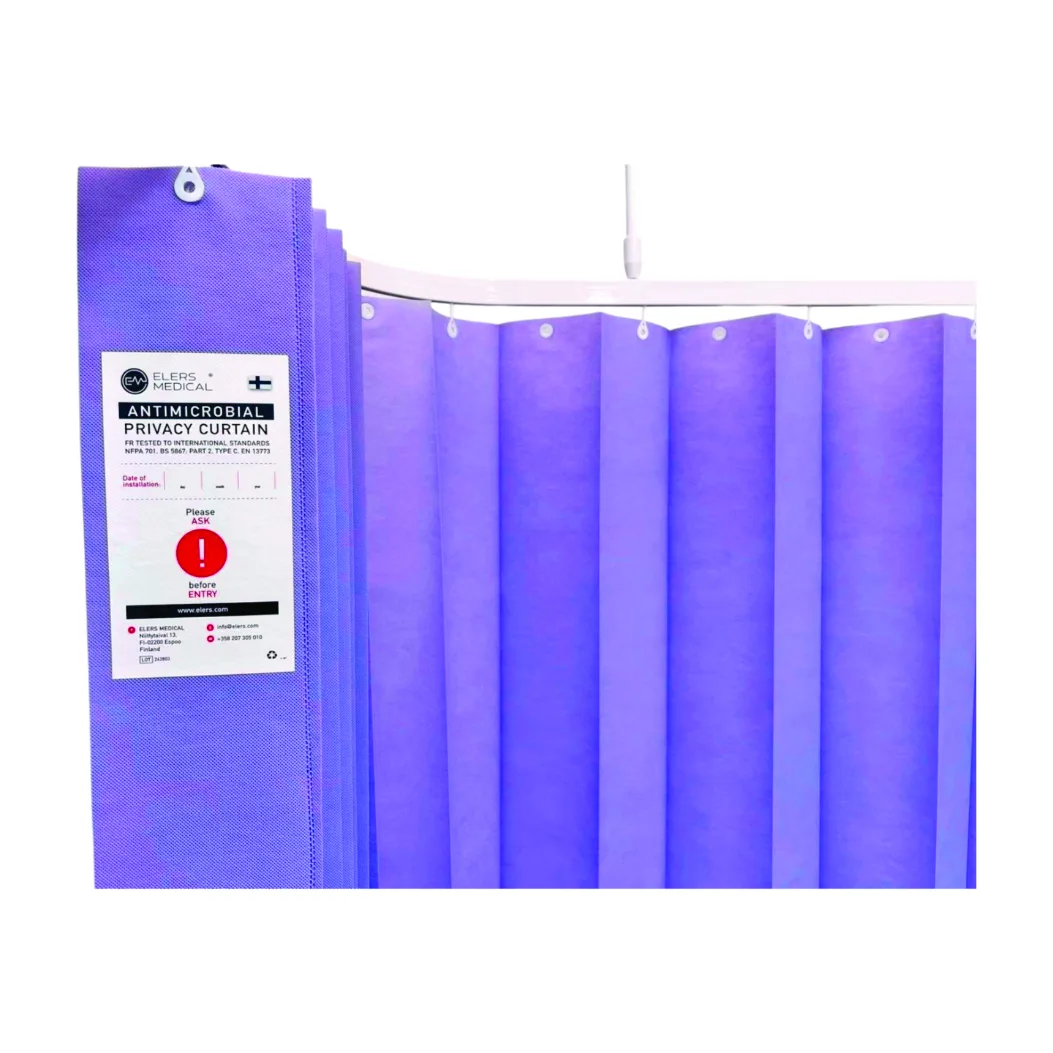
Standart renkler ve baskı desenleri
Her renk ve balon desenli baskı, tam kapalı, delikli ve üstü fileli kesimlerde antimikrobiyal ve standart perde olarak sunulur. Özel renk ve baskı seçenekleri mevcuttur; minimum sipariş miktarları geçerlidir.
Ekranda gösterilen renkler yaklaşıktır. Sipariş vermeden önce bizden kumaş numunesi isteyin.
Kanca kılavuzu
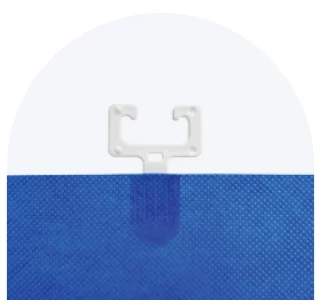
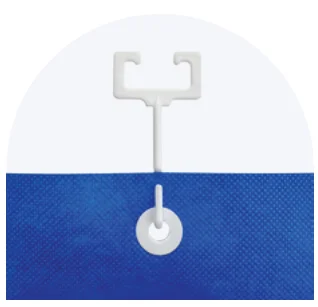
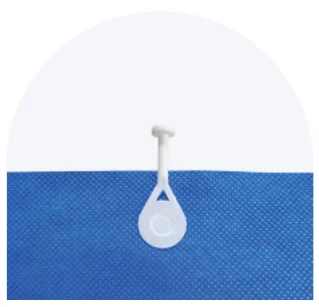
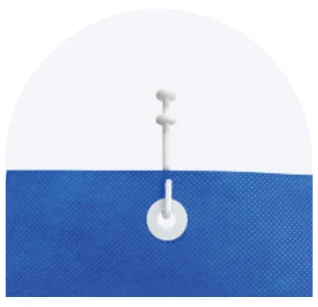
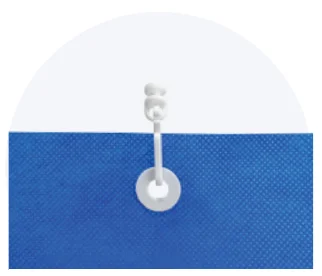
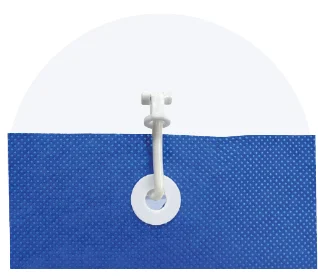
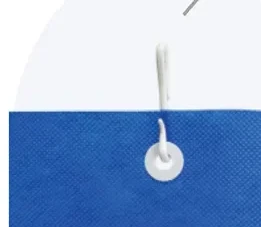
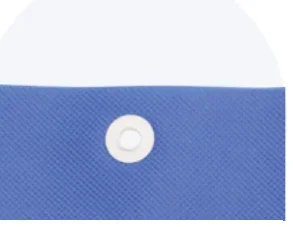
ELERS MEDICAL perdeleri, sağlık ortamlarında kullanılan yaygın perde raylarının çoğuyla uyumludur ve kancalı veya yalnızca kuşgözlü olarak tedarik edilebilir. Seçeneklerimiz mevcut ray kancası ve kaydırıcı sistemleriyle sorunsuz entegrasyon sağlar. Hangisine ihtiyacınız olduğundan emin değil misiniz? Bize rayın marka ve modelini ya da ray ile mevcut kancanın fotoğrafını gönderin.
Boyutlar ve ambalaj
Perdenin kapatması gereken ray uzunluğunu ölçün ve kullanılabilir genişliği buna uyan perdeyi seçin. Kullanılabilir genişlik, perde asıldığında oluşan pilileri hesaba katar.
| Genişlik \ boy | 2,0 m | 2,2 m | 2,4 m | 2,5 m | 2,6 m |
|---|---|---|---|---|---|
| 1.95 | 18 | 16 | 15 | 14 | 14 |
| 2.40 | 14 | 13 | 12 | 11 | 11 |
| 2.55 | 14 | 13 | 11 | 10 | 9 |
| 3.60 | 12 | 11 | 10 | 10 | 9 |
| 3.75 | 12 | 11 | 10 | 10 | 9 |
| 4.20 | 10 | 9 | 8 | 8 | 8 |
| 4.50 | 9 | 8 | 8 | 7 | 7 |
| 5.55 | 8 | 7 | 7 | 6 | 6 |
| 7.20 | 6 | 6 | 5 | 5 | 5 |
| 7.50 | 6 | 5 | 4 | 4 | 4 |
| Perde genişliği (m) | Yaklaşık kullanılabilir genişlik (m) |
|---|---|
| 1.95 | 1.55 |
| 2.40 | 1.80 |
| 2.55 | 2.05 |
| 3.60 | 2.80 |
| 3.75 | 2.90 |
| 4.20 | 3.40 |
| 4.50 | 3.60 |
| 5.55 | 4.30 |
| 7.20 | 5.60 |
| 7.50 | 5.75 |
Diğer özel boylar talep üzerine sunulur. Koli ağırlığı yaklaşık 10,5 kg. Koli ölçüleri 120 × 16,5 × 40 cm.
Montaj kılavuzu
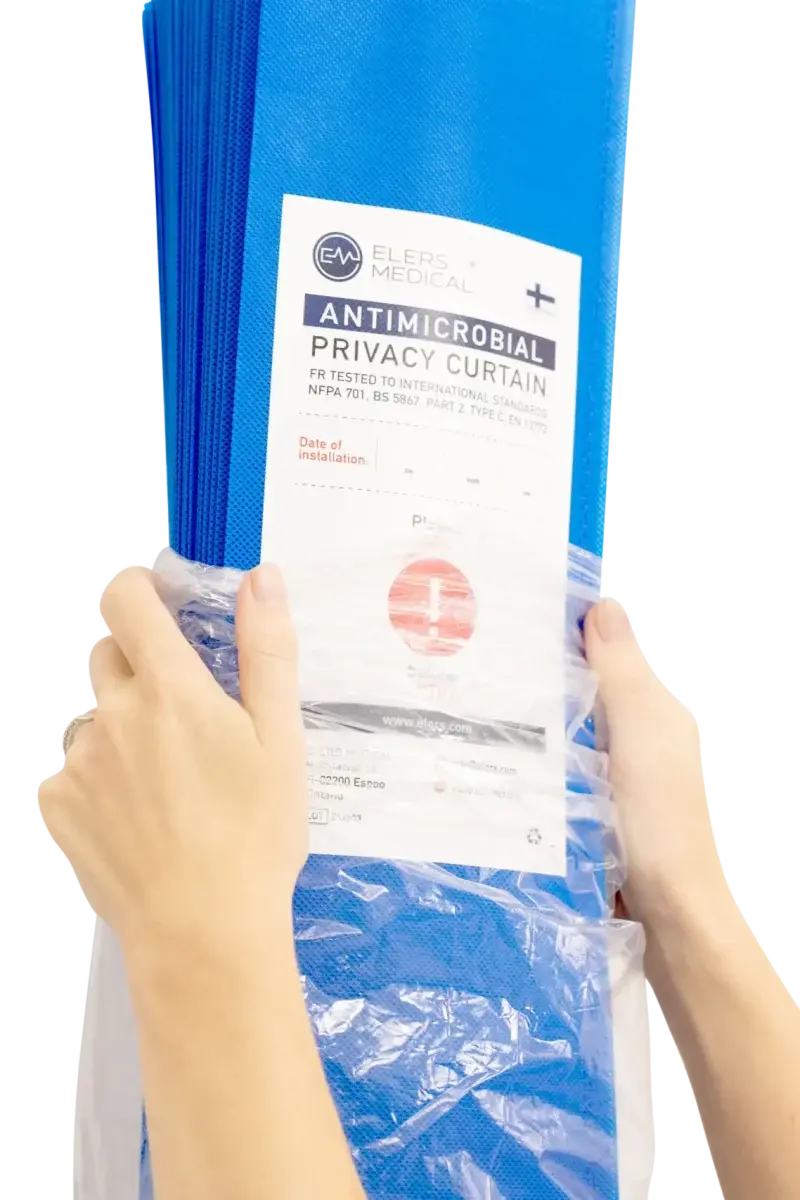
Öz denetim etiketini açığa çıkarmak için plastik kılıfı aşağı çekin ve montaj tarihini yazın.
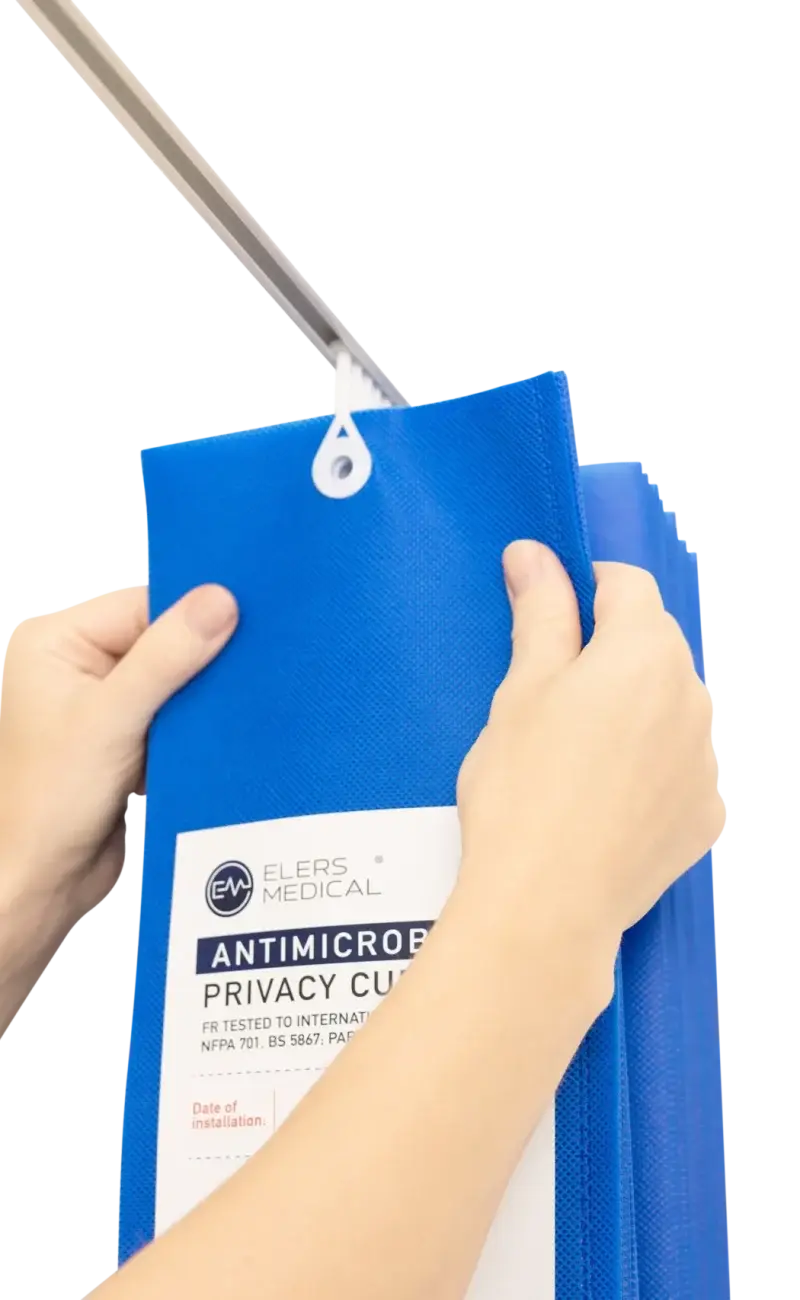
Kancaları doğrudan raya yerleştirin. Perdeler ihtiyacınıza göre kancalı veya yalnızca kuşgözlü olarak tedarik edilir.
Perde asıldıktan sonra plastik kılıfı tamamen çıkarın.
Perdeleri kuru bir ortamda, normal oda sıcaklığında ve koli dik durumda saklayın.
Perdelerin her 6 ila 12 ayda bir veya gözle görülür şekilde kirlendiğinde ya da kontamine olduğunda hemen değiştirilmesini öneriyoruz. Nihai programı hastanenizin kendi kuralları belirler.
Perde kumaşı polipropilendir (PP), kancalar ve kuşgözleri plastiktir. Perdeler yerel hastane protokollerine göre geri dönüştürülebilir veya imha edilebilir.
Bağımsız olarak test edildi
ISO 20743:2021'e göre test edilen antimikrobiyal perde malzemesi, geniş bir patojen yelpazesini log 3'ten (%99,9) fazla azaltır.
Ek testler talep üzerine sunulur.
Antibakteriyel değer (A): 2 ≤ A < 3 önemli, A ≥ 3 güçlü. Testler laboratuvar koşullarında yapılmıştır. Tüm test sonuçları talep üzerine sunulur.
Perdenin kullanım ömrü boyunca alev geciktirici.
Yayımlanmış araştırmalar
Hasta bölme perdelerine sürekli dokunulur ve nadiren değiştirilir. Bu hakemli çalışmalar, sıradan perdelerin ne kadar hızlı kontamine olduğunu ve gümüş bazlı antimikrobiyal malzemelerin buna karşı ne yaptığını gösteriyor.
“By day 3, test curtains showed increased microbial contamination (mean colony-forming units [CFU]/cm2 = 1.17) compared to control curtains (mean CFU/cm2 = 0.19). Test curtains became increasingly contaminated over time, with mean CFU/cm2 for days 17 and 21 of 1.86 and 5.11, respectively. By day 10, 1/8 test curtains tested positive for MRSA, and 5/8 were positive by day 14. Patient privacy curtains became progressively contaminated with bacteria, including MRSA. Between days 10 and 14 after being hung, curtains showed increased MRSA positivity. This may represent an opportune time to intervene, either by cleaning or replacing the curtains.”
“There was a statistically significant difference for the contact (t = 2.10, P =.047) and noncontact (t = 2.62, P =.016) rooms, with the edges having a significantly higher median than the middles. Pathogens such as methicillin-resistant Staphylococcus aureus, Enterococcus, Klebsiella, and Acinetobacter were found on the curtains, though at lower rates than in previous studies. Opportunistic fungi were also found on all curtains. Conclusions: Results of this study confirm that hospital curtains, most notably the edge but also the middle, are contaminated with pathogens, and that these areas are frequently touched by health care workers in between hand hygiene.”
“The cumulative contamination rate of the hospital privacy curtains increased over time (week 2: 15.6%, week 4: 37.0%, and week 8: 55%). Methicillin-resistant Staphylococcus aureus was not isolated from either the control or the hospital curtains during the study period. Vancomycin-resistant enterococci was not isolated from the control curtains but was isolated from 11.8% (4/34) of the hospital curtains. The contamination rate of the hospital curtains increased over time and showed a tendency to rise with an increase in the number of beds in a room.”
“Participants hands were heavily contaminated at baseline, in some cases with potentially pathogenic species. Half of the participants (n=30) acquired bacteria on their fingertips from handling curtains, illustrating that privacy curtains may be involved in the transmission of infection to emergency department patients.”
“In a culture survey (n=50), we found that 42% of hospital privacy curtains were contaminated with a antibiotic-resistant enterococci, 22% with methicillin-resistant Staphylococcus aureus, and 4% with Clostridium difficile. Hand imprint cultures demonstrated that these pathogens were easily acquired on hands. Hospital curtains are a potential source for dissemination of healthcare-associated pathogens.”
“From 32 curtains sampled, a total of 59 isolations were obtained, from those, 47 (79.6%) were considered potentially clinically relevant (Table 2), highlighting bacteria as Methicillin-resistant S. haemolyticus (MRSH), Methicillin-resistant S. cohnii (MRSC), MRSE, Methicillin-resistant S. saprophyticus (MRSS), Moraxella sp., Acinetobacter ursingii, AMP-C producer Pseudomonas oryzihabitans, Pantoea agglomerans, and Sphingomonas paucimobilis… There are significant opportunities to reduce patient exposure to frequently pathogenic bacteria in the hospital setting; patients are likely exposed to many bacteria through direct contact with white coats, curtains, and ties.”
“Twelve of 13 curtains (92%) placed during the study showed contamination within 1 week. Forty-one of 43 curtains (95%) demonstrated contamination on at least 1 occasion, including 21% with MRSA and 42% with VRE. Eight curtains yielded VRE at multiple time points: 3 with persistence of a single isolate type and 5 with different types, suggesting frequent recontamination. Privacy curtains are rapidly contaminated with potentially pathogenic bacteria.”
“Privacy curtain contamination on the burns/plastic surgery ward was determined for two separate occasions six months apart: 23 curtains on August 2015 and 26 curtains on January 2016… Curtain contamination in August 2015 was 0.7–4.7 cfu/cm2 with 22% testing positive for MRSA, whereas contamination on January 2016 was 0.6–13.3 cfu/cm2 with 31% of curtains testing positive for MRSA. Curtains on the burns/plastic surgery ward become colonized with significant quantities of bacteria.”
“Environmental screening revealed the presence of the multiple-resistant Acinetobacter species on fomite surfaces in the intensive care unit and bed linen. The major source appeared to be the curtains surrounding patients' beds. Typing by pulsed field gel electrophoresis demonstrated that the patients' isolates and those from the environment were indistinguishable… This outbreak also highlights environmental sources, particularly dry fabrics such as curtains, as an important reservoir for dissemination of acinetobacters.”
“The purpose of this study was to determine the survival of 22 gram-positive bacteria (vancomycin-sensitive and -resistant enterococci and methicillin-sensitive and -resistant staphylococci) on five common hospital materials: smooth 100% cotton (clothing), 100% cotton terry (towels), 60% cotton–40% polyester blend (scrub suits and lab coats), 100% polyester (privacy drapes), and 100% polypropylene plastic (splash aprons)… All isolates survived for at least 1 day, and some survived for more than 90 days on the various materials… The long survival of these bacteria, including MRSA and VRE, on commonly used hospital fabrics, such as scrub suits, lab coats, and hospital privacy drapes, underscores the need for meticulous contact control procedures and careful disinfection to limit the spread of these bacteria.”
“Curtains in the experimental group demonstrated significantly lower bacterial contamination than controls at all time points (P < .001). Peak contamination in the control group reached 2.1 CFU/cm² at day 30, whereas experimental curtains maintained contamination below 0.2 CFU/cm² throughout. Cost analysis revealed a 59.42% reduction in cumulative curtain-related expenditures in the experimental group. Antimicrobial disposable curtains offer superior microbial control and substantial cost savings. Integration of such curtains into infection prevention protocols may enhance environmental hygiene and resource optimization in critical care settings.”
“Bacteria were exposed to the silver ion solution for various lengths of time, and the antibacterial effect of the solution was tested… Reductions of more than 5 log10 CFU/ml of both S. aureus and E. coli bacteria were confirmed after 90 min of treatment with the silver ion solution. Significant reduction of S. aureus and E. coli cells was also observed by FC analysis… In conclusion, the results of the present study suggest that silver ions may cause S. aureus and E. coli bacteria to reach an ABNC state and eventually die.”
“A declining pipeline of clinically useful antibiotics has made it imperative to develop more effective antimicrobial therapies, particularly against difficult-to-treat Gram-negative pathogens. Silver has been used as an antimicrobial since antiquity, yet its mechanism of action remains unclear. We show that silver disrupts multiple bacterial cellular processes, including disulfide bond formation, metabolism, and iron homeostasis. These changes lead to increased production of reactive oxygen species and increased membrane permeability of Gram-negative bacteria that can potentiate the activity of a broad range of antibiotics against Gram-negative bacteria in different metabolic states, as well as restore antibiotic susceptibility to a resistant bacterial strain… This work shows that silver can be used to enhance the action of existing antibiotics against Gram-negative bacteria, thus strengthening the antibiotic arsenal for fighting bacterial infections.”
“The resulting silver sulfadiazine–immobilized celluloses provided a 6-log reduction of 10^8 CFU mL−1 of Staphylococcus aureus (Gram-positive bacteria), Escherichia coli (Gram-negative bacteria), methicillin-resistant Staphylococcus aureus (drug-resistant bacteria), vancomycin-resistant Enterococcus faecium (drug-resistant bacteria), and Candida albicans (fungi) in 30–60 minutes, and a 5-log reduction of 10^7 PFU mL−1 of MS2 virus in 120 minutes. The antibacterial, antifungal, and antiviral activities were both durable and rechargeable. Additionally, trypan blue assay suggested that the new silver sulfadiazine–immobilized celluloses sustained excellent mammal cell viability, pointing to great potentials of the new materials for a broad range of health care–related applications.”
ELERS MEDICAL®
Elers Medical Finland Oy'nin iki yönetim sistemi sertifikası vardır: ISO 9001:2015 kalite yönetimi ve ISO 14001:2015 çevre yönetimi.
Perdenin kapatmasını istediğiniz ray uzunluğunu ölçün, ardından pilileriyle birlikte yeterli kapatma sağlayan perdeyi seçmek için asılı haldeki kullanılabilir genişliği kullanın. Standart genişlikler 1,95 m ile 7,50 m, boylar 2,0 m ile 2,6 m arasındadır. 1,95 m'lik bir perde yaklaşık 1,55 m, 7,50 m'lik bir perde yaklaşık 5,75 m ray kapatır. Özel genişlik ve boylar talep üzerine sunulur; minimum sipariş miktarları ve daha uzun teslim süreleri geçerli olabilir.
ELERS MEDICAL perdeleri, uygun kancayla kullanıldığında hastane perde ray sistemlerinin çoğuna uyar. Mevcut uyumlu kancalarla kullanılmak üzere yalnızca kuşgözlü seçenek de mevcuttur. Hangi bağlantı parçasını sipariş edeceğinizden emin değilseniz, bize rayın marka ve modelini ya da ray ile mevcut kancanın fotoğrafını gönderin; doğru bağlantı parçasını belirlemenize yardımcı olalım.
Evet. ELERS MEDICAL, perde kumaşında halojen içermeyen alev geciktirici bir katkı maddesi kullanır. BS 5867-2:2008 Type C ve NFPA 701 test sonuçları ile EN 13773 sınıflandırması dahil yangın performansı belgeleri talep üzerine sunulur.
İşlem, perde kumaşında bakteri üremesini engellemek üzere tasarlanmıştır. Kumaş, tekstillerde antibakteriyel aktiviteyi ölçen uluslararası bir test yöntemi olan ISO 20743'e göre test edilmiştir. Test belgeleri talep üzerine sunulur.
ELERS MEDICAL, perdelerin her 6 ila 12 ayda bir veya hastanenizin enfeksiyon önleme ve kontrol politikası gerektiriyorsa daha erken değiştirilmesini önerir. Her klinik alan için yerel değişim programına uyun. Perdeler kan veya diğer vücut sıvılarıyla gözle görülür şekilde kontamine olursa hemen değiştirin.
Her perdenin ön pilisinde, personelin asıldığı tarihi yazabileceği bir öz denetim etiketi bulunur. Bu tarih sayesinde perdenin en son ne zaman değiştirildiği kontrol edilebilir ve bir sonraki rutin değişimin ne zaman yapılacağı hesaplanabilir.
Yelpazede Pacific Blue, Summer Blue, Light Blue, Light Green, Pastel Yellow, Latte, Forest Green, Battleship Grey, Lilac, Pink, White ve Balloon Print bulunur. Minimum sipariş miktarları ve teslim sürelerine bağlı olarak talep üzerine başka renkler de sunulabilir.
Kullanılmış perdeleri sökerken ve imha ederken hastanenizin atık politikasına ve yerel enfeksiyon önleme ve kontrol prosedürlerine uyun ve uygun atık akışını, örneğin tıbbi atık veya evsel nitelikli atık, bunlara göre belirleyin. Perde kumaşı %100 polipropilendir. Kullanılmış bir perdenin geri dönüştürülüp dönüştürülemeyeceği atık sınıflandırmasına ve atık yükleniciniz ya da yerel enfeksiyon kontrol politikanızın gerekliliklerine bağlıdır.
Hangi perdelere ihtiyacınız olduğunu bize bildirin, size bir teklifle dönelim.